qspinlock
简介
内核中的自旋锁是互斥锁。而内核中的自旋锁经过多个版本的演进, 最终是在 mcs 自旋锁 算法之上,根据kernel 本身的需求,作了改进。
我们这里不去回顾 Linux 自旋锁的历史,简单介绍下 mcs 自旋锁算法, 并详细讲解 kernel 中的 mcs自旋锁的变体。
NOTE
如果想要了解 kernel 自旋锁的演进,可以看下
该文章详细讲解了kernel自旋锁的演进,并通过举例子 的方式,讲解了各个算法(包括最新的算法),十分值 得看, 本文主要分析kernel 最新的 自旋锁算法。
MCS 自旋锁
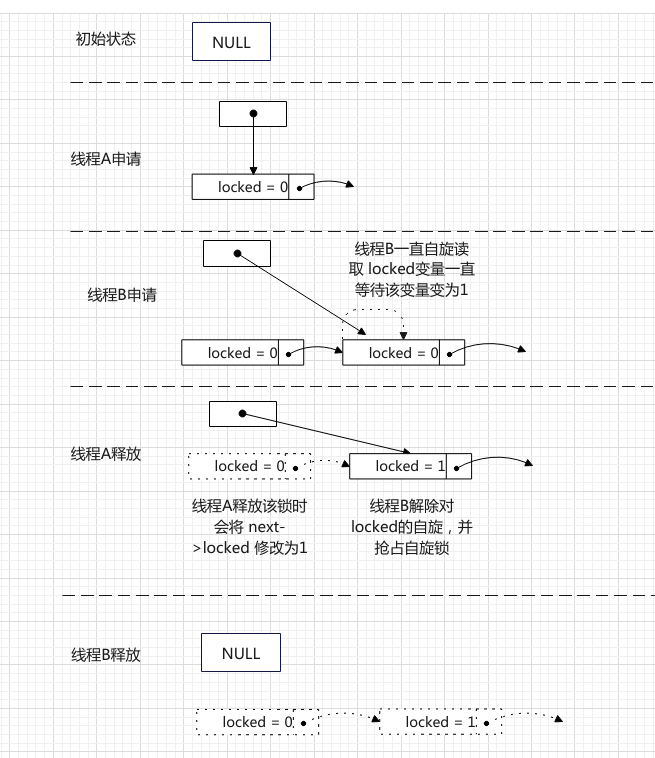
MCS 自旋锁是在为了解决票号自旋锁带来的 cache line bouncing2, 实现了一个队列,使其各自自旋各自的地址, 而不是自旋一个地址,这样就 解决了这个问题。
NOTE 1
这个我们放到附录1中讲述 什么是cache line bouncing,为什么cache line bouncing在 spinlock场景会尤为突出。
所以 MCS自旋锁 即保持票号自旋锁的保证线程获取锁的顺序的优点, 同时解决票号自旋锁带来的cache 抖动问题。但是也有缺点,我们下面会介绍。
我们先来看下 MCS自旋锁的实现
而MCS自旋锁有什么缺点呢 ?
- 更改了spinlock的相关接口
- 锁占用的内存变大
kernel 对此做了一些优化,我们来看下
KERNEL MCS 变体
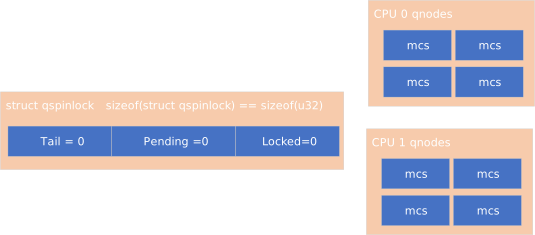
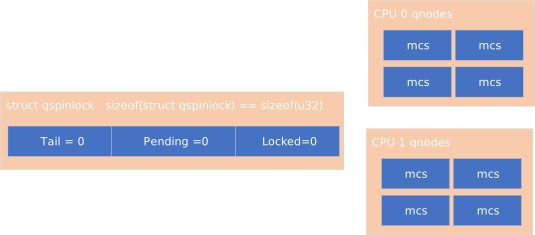
spinlock的相关数据结构(struct qspinlock),仍然保持之前的样子 大小为sizeof(u32)。但是该空间分割成主要的三个成员 (locked, pending,tail)。我们来看下kernel代码定义:
1
2
3
4
5
6
7
8
9
10
11
12
13
14
15
16
17
18
19
20
21
22
23
24
25
26
27
28
29
30
31
typedef struct qspinlock {
        union {
                atomic_t val;

                /*
                ¦* By using the whole 2nd least significant byte for the
                ¦* pending bit, we can allow better optimization of the lock
                ¦* acquisition for the pending bit holder.
                ¦*/
#ifdef __LITTLE_ENDIAN
                struct {
                        u8      locked;
                        u8      pending;
                };
                struct {
                        u16     locked_pending;
                        u16     tail;
                };
#else
                struct {
                        u16     tail;
                        u16     locked_pending;
                };
                struct {
                        u8      reserved[2];
                        u8      pending;
                        u8      locked;
                };
#endif
        };
} arch_spinlock_t;
可以看到访问该数据结构,应该使用原子操作(qspinlock.val), 根据的线程(cpu)的情况可能需要关注的东西不同, 例如: mcs.locked = 1的cpu需要关注 (qspinlock.locked_pending)成员。 而pending的cpu仅需要关注(qspinlock.locked), 我们下面会介绍具体的流程
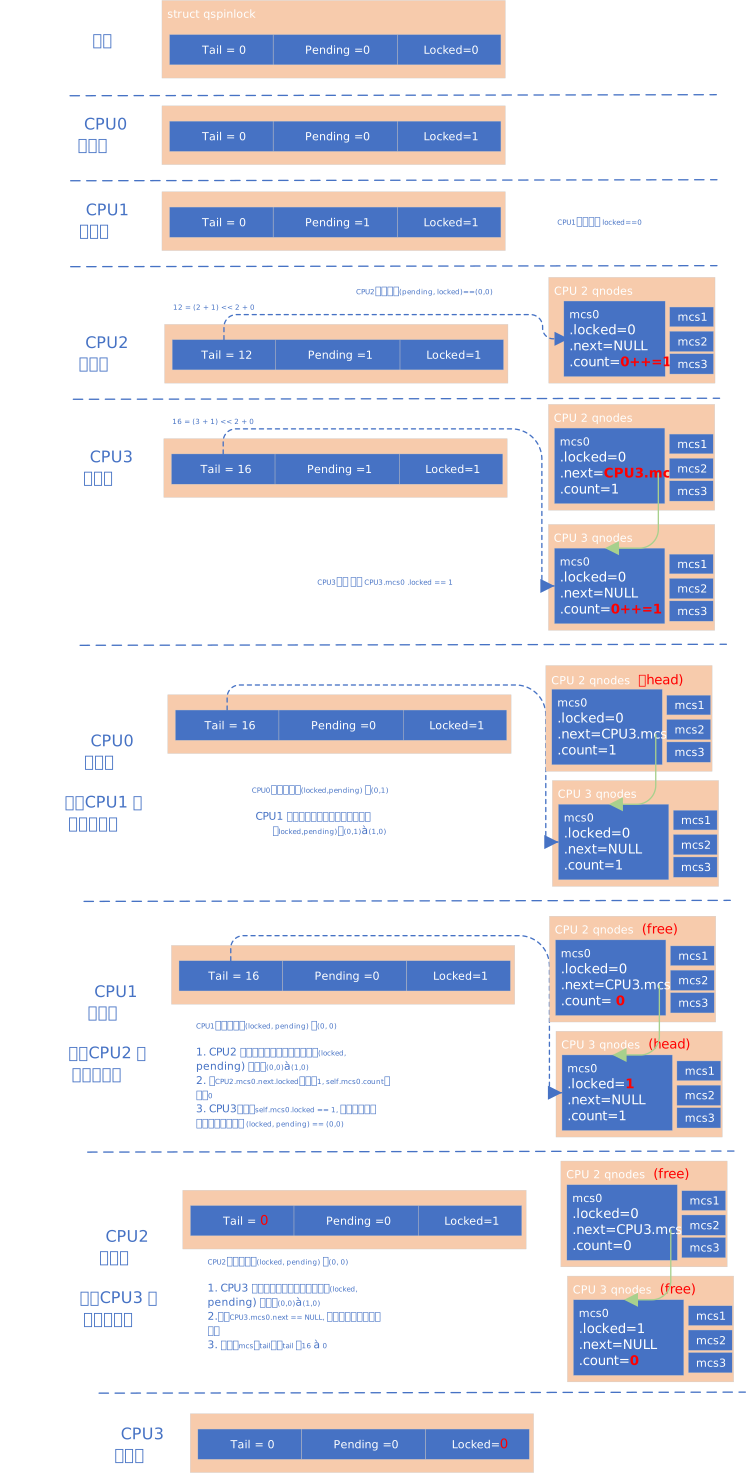
- 简单来说,是占据pending 的cpu抢占locked, 而 占据 mcs head 的cpu 抢占
locked_pending, 而非mcs head的cpu, 先抢占self.mcs.locked == 1, 等待该条件满足时,表示其为 mcs head, 然后再抢占locked_pending - 每个 cpu有四个 mcs0, 代表4中状态(代表4层执行流,线程、软中断、 硬中断、屏蔽中断), 举个例子,线程拿到了锁,这时候来了一个硬 中断,硬中断处理完后,进入软中断处理及流程,这时拿了一把锁, 此时又来了一个硬中断,该中断处理中又拿了一个自旋锁,还未解锁时, 来了一个NMI又拿了一个自旋锁。 这样每个CPU最多持有四把自旋锁。而 每个自旋锁,如果都需要使用 mcs结构 enqueue, 最多需要4个mcs结构。
- tail的计算也是基于上面。每个cpu最多拿四个mcs, 所以tail[bit:1,bit:0] 用来表示当前用了几个自旋锁。cpu index记录在剩余的bits中。另外
tail == 0有特殊的含义 – 表示没有 mcs 在抢占自旋锁。所以不存在cpu0.mcs0的这种情况,需要将cpu_index++, 也就是下面的公式:1
tail = ((cpu_index + 1) << 2) + mcs_index
代码分析
NOTE
下面 频繁使用三元组 (tail, pending, locked) , 例如(0, 0, 1) 表示 locked = 1, pending = 0, tail = 0
另外 tail = n , 表示tail位被占用
tail = z, 则表示tail 为任意值
locked, pending == x, y 表示任意值
我们直接看 queue_spin_lock()的相关代码:
queued_spin_lock
1
2
3
4
5
6
7
8
9
10
static __always_inline void queued_spin_lock(struct qspinlock *lock)
{
        u32 val;
        //=============(1)=================
        val = atomic_cmpxchg_acquire(&lock->val, 0, _Q_LOCKED_VAL);
        if (likely(val == 0))
                return;
        //============(2)==================
        queued_spin_lock_slowpath(lock, val);
}
- 查看
lock->val是否为0, 如果为0, 则说明没有人在使用该锁, 将 (0, 0, 0) 修改为 (0, 0, 1) - 如果有人占用锁,则走slowpath流程
slow path
lock pending – part 1
1
2
3
4
5
6
7
8
9
10
11
12
13
14
15
16
17
18
19
20
21
22
23
24
25
26
27
28
29
30
31
32
33
34
35
36
37
38
39
40
41
void queued_spin_lock_slowpath(struct qspinlock *lock, u32 val)
{
        struct mcs_spinlock *prev, *next, *node;
        u32 old, tail;
        int idx;

        BUILD_BUG_ON(CONFIG_NR_CPUS >= (1U << _Q_TAIL_CPU_BITS));
        //===============(1)==================
        if (pv_enabled())
                goto pv_queue;

        if (virt_spin_lock(lock))
                return;

        /*
         * Wait for in-progress pending->locked hand-overs with a bounded
         * number of spins so that we guarantee forward progress.
         *
         * 0,1,0 -> 0,0,1
         */
        //===============(2)==================
        if (val == _Q_PENDING_VAL) {
                int cnt = _Q_PENDING_LOOPS;
                val = atomic_cond_read_relaxed(&lock->val,
                                        (VAL != _Q_PENDING_VAL) || !cnt--);
        }

        /*
        ¦* If we observe any contention; queue.
        ¦*/
        //===============(3)==================
        if (val & ~_Q_LOCKED_MASK)
                goto queue;
        /*
         * trylock || pending
         *
         * 0,0,* -> 0,1,* -> 0,0,1 pending, trylock
         */
        //===============(4)==================
        val = queued_fetch_set_pending_acquire(lock);
        ...
- 我们这里先不关注半虚拟化
- 如果是(0, 1, 0), 则等待其进入(0, 0, 1), 这样做的好处是,如果其进入了 (0,0,1) 则直接抢占pending位,状态为(0,1,1), 就不用走queue的流程
- 如果除 locked位,其他位不为0, 则说明有被别的线程抢占了,则走queue的流程
- 该代码为:
1
2
3
4
static __always_inline u32 queued_fetch_set_pending_acquire(struct qspinlock *lock)
{
     return atomic_fetch_or_acquire(_Q_PENDING_VAL, &lock->val);
}
这里进行按位或操作,并返回之前的值,我们来想下在原子操作前有那 几种可能的情况。
- (z, 1, y) : 进行逻辑或操作无影响。但是本次抢占锁失败
- (n, 0, y) : !! 这种情况就打乱了顺序,不允许, 并且需要将pending位还原
- (0, 0, 1) : 抢占pending位,spin lock位
- (0, 0, 0) : 抢占了pending位,然后这时,只有自己能抢占lock位,再抢占lock位
我们继续分析(4) 之后的代码:
lock pending – part2
1
2
3
4
5
6
7
8
9
10
11
12
13
14
15
16
17
18
19
20
21
22
23
24
25
26
27
28
29
30
31
32
33
34
35
36
37
38
39
40
41

        /*
         * If we observe contention, there is a concurrent locker.
         *
         * Undo and queue; our setting of PENDING might have made the
         * n,0,0 -> 0,0,0 transition fail and it will now be waiting
         * on @next to become !NULL.
         */
        //============(1)====================
        if (unlikely(val & ~_Q_LOCKED_MASK)) {

        //============(1.1)====================
                /* Undo PENDING if we set it. */
                if (!(val & _Q_PENDING_MASK))
                        clear_pending(lock);

                goto queue;
        }

        /*
         * We're pending, wait for the owner to go away.
         *
         * 0,1,1 -> 0,1,0
         *
         * this wait loop must be a load-acquire such that we match the
         * store-release that clears the locked bit and create lock
         * sequentiality; this is because not all
         * clear_pending_set_locked() implementations imply full
         * barriers.
         */
        //===============(2)================
        if (val & _Q_LOCKED_MASK)
                atomic_cond_read_acquire(&lock->val, !(VAL & _Q_LOCKED_MASK));
        /*
         * take ownership and clear the pending bit.
         *
         * 0,1,0 -> 0,0,1
         */
        clear_pending_set_locked(lock);
        lockevent_inc(lock_pending);
        return;
- 除了locked字段以外还有值,则抢锁失败
- pending字段有值,则为(z, 1, y), 抢锁失败不需要做什么事情,
- pending 字段未有值,那tail字段肯定有值,则为(n, 0, y), 抢锁 失败,还需要将pending位还原为0
- 以上两种情况都需要入队
- 这种情况为 (0, 0, y)
- 如果为 (0, 0, 1), 则spin lock位,等待其变为0
- 如果位 (0, 0, 0), clear pending 并且 抢占 lock位
queue – part1
1
2
3
4
5
6
7
8
9
10
11
12
13
14
15
16
17
18
19
20
21
22
23
24
25
26
27
28
29
30
31
32
void queued_spin_lock_slowpath(struct qspinlock *lock, u32 val)
{
        ...
queue:
        lockevent_inc(lock_slowpath);
pv_queue:
        //=================(1)=======================
        node = this_cpu_ptr(&qnodes[0].mcs);
        idx = node->count++;
        tail = encode_tail(smp_processor_id(), idx);

        /*
         * 4 nodes are allocated based on the assumption that there will
         * not be nested NMIs taking spinlocks. That may not be true in
         * some architectures even though the chance of needing more than
         * 4 nodes will still be extremely unlikely. When that happens,
         * we fall back to spinning on the lock directly without using
         * any MCS node. This is not the most elegant solution, but is
         * simple enough.
         */
        //=================(2)=======================
        if (unlikely(idx >= MAX_NODES)) {
                lockevent_inc(lock_no_node);
                while (!queued_spin_trylock(lock))
                        cpu_relax();
                goto release;
        }

        //=================(3)=======================
        node = grab_mcs_node(node, idx);
        ...
}
- 获取mcs结构,关于该node的count,在 qnodes[0].mcs中记录。
encode_tail()会根据 当前cpu idx和原来的count值计算出一个 值作为tail的值。 idx >= MAX_NODES其实是不正常的(说明已经获取了 MAX_NODES(4) 次锁), 注释中写了可能的原因,我们这里先不细看 (!!后续补充!!)- 获取 qnodes[idx].mcs node
queue – part2
1
2
3
4
5
6
7
8
9
10
11
12
13
14
15
16
17
18
19
20
21
22
23
24
25
26
27
28
29
30
31
32
33
34
35
36
void queued_spin_lock_slowpath(struct qspinlock *lock, u32 val)
{
        ...
        /*
         * 上节代码:
         * idx = node->count++;
         */
		...
        /*
         * Keep counts of non-zero index values:
         */
        lockevent_cond_inc(lock_use_node2 + idx - 1, idx);

        //=============(1)===============
        /*
        ¦* Ensure that we increment the head node->count before initialising
        ¦* the actual node. If the compiler is kind enough to reorder these
        ¦* stores, then an IRQ could overwrite our assignments.
        ¦*/
        barrier();
        //=============(2)===============
        node->locked = 0;
        node->next = NULL;
        pv_init_node(node);

        /*
        ¦* We touched a (possibly) cold cacheline in the per-cpu queue node;
        ¦* attempt the trylock once more in the hope someone let go while we
        ¦* weren't watching.
        ¦*/
        //=============(3)===============
        if (queued_spin_trylock(lock))
                goto release;

		...
}
locking/qspinlock: Ensure node->count is updated before initialising node
commit 11dc13224c975efcec96647a4768a6f1bb7a19a8 该 barrier是为了避免编译器将
init node和idx = node->count++顺序搞乱。 在单执行流跑的时候不会有问题。当遇到下面的情况 ``` (1) 未加barrier()之前, 编译器乱序 normal thread 触发中断 //乱序 init node[0] init node[0] idx = node->count++(2) 加了barrier normal thread idx = node->count++ 触发中断 init node[1] init node[0] ``` 未加 barrier()之前,会遇到中断执行流和normal thread执行流,使用 一个node的情况。
- 初始化该node
- 这时候,我们只修改了node, 如果能抢到锁,恢复原来的node也很好恢复。 所以尝试抢锁,抢到就血赚。
queue – part3
1
2
3
4
5
6
7
8
9
10
11
12
13
14
15
16
17
18
19
20
21
22
23
24
25
26
27
28
29
30
31
32
33
34
35
36
37
38
39
40
41
42
43
44
45
46
47
48
49
50
51
52
53
54
55
56
void queued_spin_lock_slowpath(struct qspinlock *lock, u32 val)
{
        /*
         * 上节代码:(1)
         * node->locked = 0;
         * node->next = NULL;
         */
        ...
        /*
        ¦* Ensure that the initialisation of @node is complete before we
        ¦* publish the updated tail via xchg_tail() and potentially link
        ¦* @node into the waitqueue via WRITE_ONCE(prev->next, node) below.
        ¦*/
        //=============(1)===============
        smp_wmb();

        /*
        ¦* Publish the updated tail.
        ¦* We have already touched the queueing cacheline; don't bother with
        ¦* pending stuff.
        ¦*
        ¦* p,*,* -> n,*,*
        ¦*/
        //==============(2)===============
        old = xchg_tail(lock, tail);
        next = NULL;

        /*
        ¦* if there was a previous node; link it and wait until reaching the
        ¦* head of the waitqueue.
        ¦*/
        //==============(3)===============
        if (old & _Q_TAIL_MASK) {
                prev = decode_tail(old);

                /* Link @node into the waitqueue. */
        //==============(4)===============
                WRITE_ONCE(prev->next, node);

                pv_wait_node(node, prev);
        //==============(5)===============
                arch_mcs_spin_lock_contended(&node->locked);

                /*
                ¦* While waiting for the MCS lock, the next pointer may have
                ¦* been set by another lock waiter. We optimistically load
                ¦* the next pointer & prefetch the cacheline for writing
                ¦* to reduce latency in the upcoming MCS unlock operation.
                ¦*/
        //==============(6)===============
                next = READ_ONCE(node->next);
                if (next)
                        prefetchw(next);
        }
        ...
}
- 关于此处的分析,请看
- publish the updated tail (替换tail)
- 判断 old 是否有 tail值,如果有,则说明mcs链表中有成员, 需要获取 prev, 并且更新
prev->next - 更新 prev->next
这时需要自旋等待 node->locked == 1
1 2 3 4
#define arch_mcs_spin_lock_contended(l) \ do { \ smp_cond_load_acquire(l, VAL); \ } while (0)- 因为在(5)处等待了一段时间,很可能node->next就有值了,因为这时候抢到了 锁,如果有next需要再将
next->locked = 1, 但是距离写操作还有一些指令, 这里执行prefetchw操作,暗示cpu会有对next地址的写操作,使其在写操作 发生之前,将该地址的内容load到 cache中。
queue – part4
1
2
3
4
5
6
7
8
9
10
11
12
13
14
15
16
17
18
19
20
21
22
23
24
25
26
27
28
29
30
31
32
void queued_spin_lock_slowpath(struct qspinlock *lock, u32 val)
{
        ...
        /*
        ¦* we're at the head of the waitqueue, wait for the owner & pending to
        ¦* go away.
        ¦*
        ¦* *,x,y -> *,0,0
        ¦*
        ¦* this wait loop must use a load-acquire such that we match the
        ¦* store-release that clears the locked bit and create lock
        ¦* sequentiality; this is because the set_locked() function below
        ¦* does not imply a full barrier.
        ¦*
        ¦* The PV pv_wait_head_or_lock function, if active, will acquire
        ¦* the lock and return a non-zero value. So we have to skip the
        ¦* atomic_cond_read_acquire() call. As the next PV queue head hasn't
        ¦* been designated yet, there is no way for the locked value to become
        ¦* _Q_SLOW_VAL. So both the set_locked() and the
        ¦* atomic_cmpxchg_relaxed() calls will be safe.
        ¦*
        ¦* If PV isn't active, 0 will be returned instead.
        ¦*
        ¦*/
        //================(1)======================
        if ((val = pv_wait_head_or_lock(lock, node)))
                goto locked;

        //================(2)======================
        val = atomic_cond_read_acquire(&lock->val, !(VAL & _Q_LOCKED_PENDING_MASK));
        ...
}
- pv先不看 !!!!!
- 自旋
lock->lock_pending == 0(n, 1, 0) 或者 (n,0,1) –>(n, 0, 0), 这里只有该进程自旋这个地址,所以如果变为(n, 0, 0) , 只有这个进程可以 抢到。
locked
1
2
3
4
5
6
7
8
9
10
11
12
13
14
15
16
17
18
19
20
21
22
23
24
25
26
27
28
29
30
31
32
33
34
35
36
37
38
39
40
41
42
43
44
45
46
47
48
49
50
51
52
53
54
55
56
void queued_spin_lock_slowpath(struct qspinlock *lock, u32 val)
{
locked:
        /*
        ¦* claim the lock:
        ¦*
        ¦* n,0,0 -> 0,0,1 : lock, uncontended
        ¦* *,*,0 -> *,*,1 : lock, contended
        ¦*
        ¦* If the queue head is the only one in the queue (lock value == tail)
        ¦* and nobody is pending, clear the tail code and grab the lock.
        ¦* Otherwise, we only need to grab the lock.
        ¦*/

        /*
        ¦* In the PV case we might already have _Q_LOCKED_VAL set, because
        ¦* of lock stealing; therefore we must also allow:
        ¦*
        ¦* n,0,1 -> 0,0,1
        ¦*
        ¦* Note: at this point: (val & _Q_PENDING_MASK) == 0, because of the
        ¦*       above wait condition, therefore any concurrent setting of
        ¦*       PENDING will make the uncontended transition fail.
        ¦*/
        //==============(1)====================
        if ((val & _Q_TAIL_MASK) == tail) {
                //==============(2)====================
                if (atomic_try_cmpxchg_relaxed(&lock->val, &val, _Q_LOCKED_VAL))
                        goto release; /* No contention */
        }

        /*
        ¦* contended path; wait for next if not observed yet, release.
        ¦*/
        //==============(3)====================
        if (!next)
                next = smp_cond_load_relaxed(&node->next, (VAL));

        /*
        ¦* Either somebody is queued behind us or _Q_PENDING_VAL got set
        ¦* which will then detect the remaining tail and queue behind us
        ¦* ensuring we'll see a @next.
        ¦*/
        //==============(4)====================
        set_locked(lock);

        //==============(5)====================
        arch_mcs_spin_unlock_contended(&next->locked);
        pv_kick_node(lock, next);

release:
        /*
        ¦* release the node
        ¦*/
        __this_cpu_dec(qnodes[0].mcs.count);
}
- 如果tail 就是 当前的mcs, 说明,没有其他人抢了,这时将 状态变为 (0, 0, 1)
atomic_try_cmpxchg_relaxed()- 如果lock->val == val , val保持不变,返回值为true
- 如果Lock->val != val, val=lock->val, 返回值为false
- 所以, 如果返回为真,说明为(this_node, 0, 0)则 直接替换成(0, 0, 1) 即可, 并且释放该mcs
- 如果next没有值,并且这时
lock->tail != this_node, 说明 有人抢锁,并执行完old = xchg_tail(lock, tail);这行代码, 但是还没有执行WRITE_ONCE(prev->next, node);, 这行代码, 这时,需要等待 node->next 被赋值。 这时,可以抢占锁了。
1
commit c61da58d8a9ba9238250a548f00826eaf44af0f7
将next->locked 赋值为1
1
2
#define arch_mcs_spin_unlock_contended(l)                               \
        smp_store_release((l), 1)